Article
How Does Layering in Money Laundering Work

Uros Pavlovic
February 8, 2024
Money laundering, a term that frequently surfaces in financial crime discussions, remains a significant global challenge, especially for financial institutions like banks and neobanks. At the heart of this illicit activity lies a complex process known as 'layering.' This article aims to demystify the concept of layering in money laundering, shedding light on its intricacies and implications for businesses in the financial sector.
Understanding layering is crucial for these institutions, as it directly impacts their risk management and compliance strategies. By exploring this concept, we equip our readers with the knowledge needed to identify and combat this covert practice.
What are the basics of money laundering?

Money laundering is typically executed in three distinct stages: Placement, Layering, and Integration. Each stage plays a critical role in obscuring the origins of illicit funds, making them appear legitimate.
Placement: This is the initial stage where the illegally obtained money is introduced into the financial system. This could be done through various means, such as depositing into banks, purchasing assets, or using the money for gambling.
Layering: The focal point of our discussion, layering, involves complex financial transactions designed to conceal the origin of the money. This stage is intricately structured to create a confusing web of transactions that distances the money from its source. The methods used can range from wire transfers between different accounts across the globe to investments in financial instruments.
Integration: The final stage, where the now 'cleaned' money is integrated into the economy, often through seemingly legal transactions or investments. At this point, the money re-enters the economy and is indistinguishable from legitimate assets.
Understanding these stages, particularly layering, is pivotal for financial institutions. It enables them to implement effective monitoring systems to detect and prevent such illicit activities.
Money laundering statistics
There is a variety of trends that highlight the prevalence and intricacies of layering in money laundering activities. But we’ll get into the details a bit later in the article. For now, let’s take a look at specific statistics that illustrate the impact money laundering has on the financial market. These figures not only show the scale of this issue but also underscore the importance of sophisticated detection and prevention methods.
Recently, it was revealed that an estimated amount of money laundered worldwide in one year is 2 - 5% of global GDP, or $800 billion. This translates to $2 trillion in current US dollars. Of course, due to the secretive nature of the money laundering cycle, giving out more precise estimates as to financial loss is extremely difficult. However, there’s no question that banks and neobanks need to reevaluate their defense strategies against money laundering processes and other forms of fincrime. There are glaring examples of how current protection measures are crumbling. According to Reuters, Britain's financial regulator, it had fined HSBC 63.95 million pounds ($85.16 million) for failings in its anti-money laundering processes.
The process of layering in money laundering
The process of layering in money laundering is both complex and deliberately obfuscated. It typically involves multiple transactions, which may include the creation of fake bank accounts or the utilization of synthetic money mules. The primary objective is to sever the traceable link between the funds and their illegal source.
During this phase, money launderers may engage in a flurry of banking activities. These can range from frequent interbank transfers, both domestic and international, to converting money into monetary instruments like stocks, bonds, or even cryptocurrencies. Each transaction is designed to layer the trail, making it increasingly difficult for authorities to trace the original source of the funds.
Different types of money laundering
While our focus remains on layering, it is essential to understand that money laundering manifests in various forms, each with unique methods and challenges. Beyond the traditional model involving placement, layering, and integration, money laundering can take numerous other forms:
Trade-based money laundering: Involves over or under-invoicing of goods and services to move money illegally. This method disguises the movement of money as legitimate trade transactions.
Structuring or smurfing: This technique involves breaking down large amounts of money into smaller, less suspicious amounts. These smaller amounts are then deposited into banks or other financial institutions over time to avoid detection.
Cash-intensive businesses: Money launderers often use businesses that handle a high volume of cash (like casinos, car washes, or nightclubs) to co-mingle illicit funds with legitimate business earnings.
Real estate laundering: Illicit funds are used to purchase real estate. The property is then sold, and the money re-enters the economy as legitimate proceeds from property sales.
Use of digital currencies: With the rise of cryptocurrencies, money launderers increasingly use digital currencies to move funds due to their perceived anonymity and lack of regulation.
Each of these methods can, and often do, involve layering processes to complicate the money trail further and evade detection by authorities.
Detecting layering: challenges and solutions
Detecting layering in money laundering is a formidable challenge due to its intricate and concealed nature. Financial institutions often grapple with identifying the subtle signs that differentiate legitimate financial activity from layering.
Challenges in Detection
Complexity of transactions: Layering involves a series of complex and often international transactions, making detection difficult.
Rapid evolution of techniques: As regulatory bodies catch up, launderers continually evolve their methods, staying one step ahead.
Utilizing technology and anonymous channels: The advent of digital banking and cryptocurrencies has added a layer of anonymity to transactions, complicating the tracking process.
Solutions and Strategies
Advanced analytical tools: Utilizing AI and machine learning algorithms can help in identifying patterns indicative of layering.
Enhanced due diligence: Implementing stringent verification processes for high-risk customers and transactions.
Collaboration and information sharing: sharing information among financial institutions and with regulatory bodies can help in tracking and understanding evolving laundering methods.
Employee training: Regular training for staff to recognize signs of money laundering and layering.
Your company's risk intelligence platform, leveraging alternative data and machine learning, stands as a testament to the technological advancements aiding this fight. By interpreting digital signals such as phone, email, IP, browser, and device data, these platforms provide an additional layer of defense in detecting suspicious activities that could be indicative of money laundering.
The impact of layering on financial crime (fincrime)
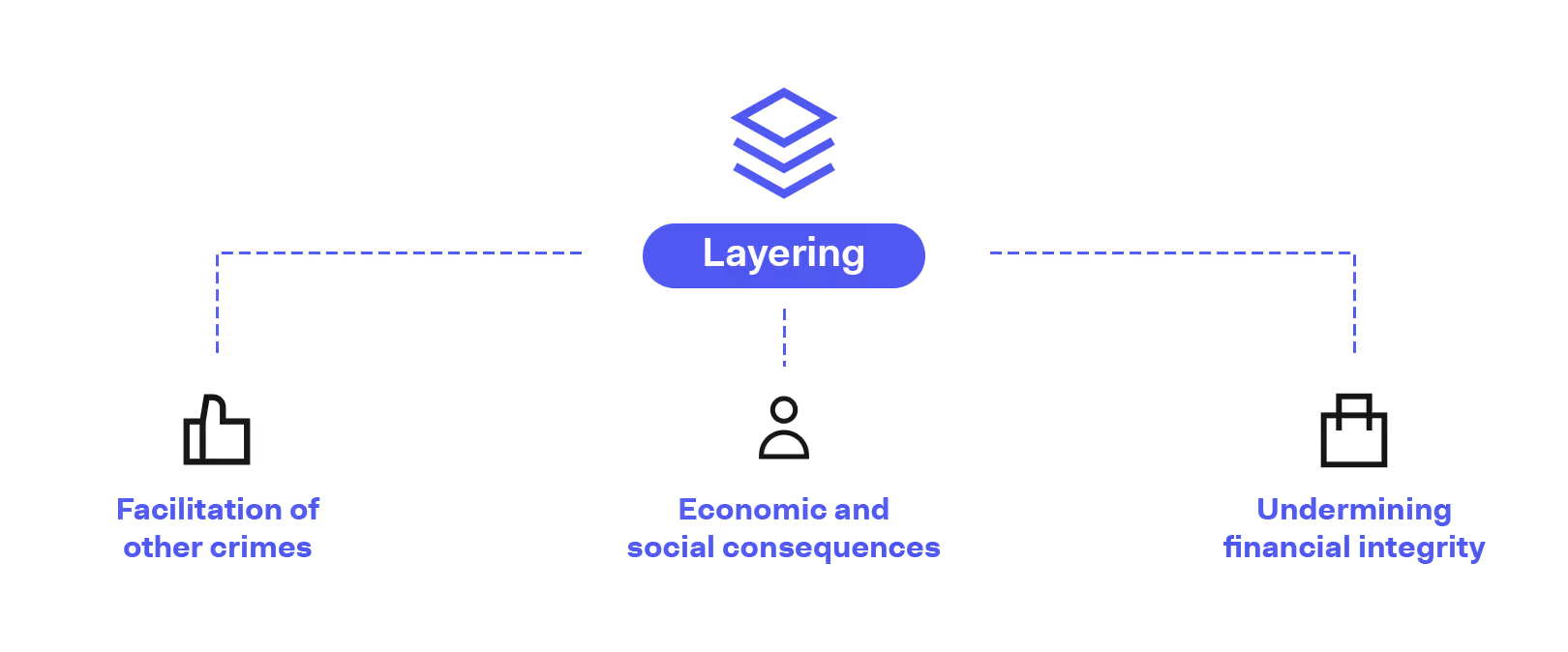
Layering in money laundering is not just a standalone issue; it significantly contributes to the broader landscape of financial crime. By effectively disguising the origins of illicit funds, layering enables criminal activities to thrive and proliferates financial crime, or 'fincrime'.
Below we’re having a closer look at the key impacts layering has on fincrime:
Facilitation of other crimes: profits from crimes like drug trafficking, terrorism financing, or human trafficking often pass through the layering process.
Economic and social consequences: layered money can distort asset and property values, impacting economies and communities.
Undermining financial integrity: persistent layering erodes trust in financial systems and institutions.
The issues of money muling and mule accounts are closely tied to layering. Money mules are individuals or accounts used to move and launder illicit funds, often unknowingly. Detecting and preventing these activities is essential in disrupting the layering stage of money laundering. Businesses can seek out ways to spot money mule red flags, before setting up effective strategies to prevent such fincrime activities.
In this section, upcoming statistics and findings will shed light on the scope and effects of layering within the realm of fincrime.
Global and regulatory perspectives on layering
The fight against layering in money laundering is a global endeavor, involving international laws and cooperative efforts. Regulatory bodies worldwide have implemented various measures to combat this sophisticated stage of money laundering.
Global Initiatives:
- FATF Recommendations: The Financial Action Task Force (FATF) provides international standards and recommendations to prevent money laundering.
- AML Regulations: Anti-Money Laundering (AML) regulations across different countries enforce due diligence, reporting, and recordkeeping requirements for financial institutions.
- Cross-Border Cooperation: sharing of financial intelligence and collaboration between countries is critical in tracing and stopping layered transactions.
Adherence to these regulations is not just about compliance; it's a crucial step for financial institutions in safeguarding against layering and other money laundering activities.
Money laundering detection: trends and predictions
The landscape of money laundering, particularly layering, is continuously evolving. As regulatory measures tighten, launderers adapt, leading to an ongoing cat-and-mouse game.
Emerging Trends:
Increased use of cryptocurrencies: the anonymity of digital currencies presents new challenges for tracking layered funds.
Sophistication in layering techniques: launderers are expected to employ more advanced and less detectable methods.
Greater reliance on technology: institutions will increasingly rely on AI, machine learning, and data analytics for detection.
Enhanced regulatory technologies (RegTech): developments in RegTech are anticipated to provide more robust tools for monitoring and reporting suspicious activities.
Global standardization of AML practices: a move towards more unified global AML standards and practices is likely.
Increased public awareness: more emphasis on educating the public and financial professionals about money laundering risks and signs.
As these trends develop, the need for innovation in detection tools and strategies becomes ever more apparent. Financial institutions must stay informed and adapt to these changes to effectively combat money laundering.
Conclusion
Understanding and combating layering in money laundering is pivotal for maintaining the integrity of financial systems worldwide. We have explored the complexities of layering, the challenges it poses, and the tools required to detect and prevent it.
Financial institutions, powered by advancements in technology and guided by stringent regulatory frameworks, play a critical role in this ongoing battle. Through continuous education, vigilance, and collaboration, the fight against money laundering, particularly the sophisticated practice of layering, can be won.
To discover more about how to put a stop to various online fraud activities (such as money muling, fake accounts, and so on), feel free to reach out to our experts.